LANGUAGE, LEGITIMACY, AND THE POLITICS OF GETTING PUBLISHED
20 June 2025
By Anisa Pinatih
Lately, the world feels like it’s spinning in every direction at once: wars, budget cuts, sanctions, AI races, and endless political unrest. It’s chaotic. And yet in the quieter corners of academia, things seem unchanged: research still has to be written in a certain kind of English, published in certain kinds of journals, and follow certain kinds of rules. But if we look closer, between citations and peer reviews, the geopolitics seeps in.
A system built on (old) power
My younger self naively believed that academic publishing was 100% objective, neutral, and above politics. But seven years working in the sector, it has become clearer to me that the dominance of English, the gatekeeping by elite journals, and even who gets cited, these are not just scholarly preferences. They’re tied to global power structures, colonial legacies, and shifting alliances.
English became the language of academia (or international language for that matter) not by accident, but through history and colonial, economic influences. The Global North journals still dominate the rankings and set citation norms. Scholars from the Global South often face not only linguistic hurdles but also implicit bias.
I’ve seen the evidence time and time again that language isn’t just about clarity, but also about framing. What’s considered a global issue is often filtered through Western perspectives. Topics like indigenous knowledge systems or localized conflicts are seen as niche unless validated by a Western co-author or institution. In this way, academic publishing quietly mirrors the same hierarchies we see in diplomacy or global markets.
One of our clients wrote about the impacts of foreign companies’ establishment on the indigenous people in the deep jungle of Indonesia. It conveyed probably the most important message ever. But what struck me was not the message per se. It was the reason I was involved in the first place (as an English language editor). The paper had to be published in Europe, with European co-authors, to meet the expectations of international visibility and credibility.
It’s not only about what is said
I’ve also seen peer reviews tone being especially harsh when it is apparent that English is not the authors' first language. Comments focus more on language or rhetoric than substance. And yet, in a world where Global South scholars are repeatedly told their English isn’t academic enough, we've also watched elite academics, like Harvard’s Francesca Gino, fall for far graver offenses like data fabrication. Clearly, some people get the benefit of the doubt or get published not because their ideas are better, but because they sound more polished or come from the “right” institution. It’s not only what is said, but who says it.
I’ve felt this bias firsthand. After graduated from my Master’s, I unknowingly challenged the views of a global scholar in the field dominated by global scholars, assuming that academic publishing welcomed debate. I was wrong. Without prior publication record and with a local affiliation, I lacked the institutional legitimacy to be heard. That paper was rejected four times before it finally found a home–not because the argument changed, but because I learned how to phrase it more cautiously.
Today, AI tools offer new support for scholars, helping them meet the linguistic expectations of international publishing. But these tools, too, are trained on dominant language norms so they essentially replicate the same academic standards.
New hierarchies emerge
AI tools like ChatGPT are claimed to have leveled the playing field in academia, helping non-native English speakers polish their writing and compete more fairly. But new research from Stanford scholars Haley Lepp and Daniel Scott Smith suggests otherwise.
With the rise of LLMs, language-based discrimination in peer review hasn’t disappeared: it’s just evolved. Analyzing 80,000 peer reviews, Lepp and Smith found that since idiosyncrasies (and human grammatical errors) are disappearing, reviewers have started using AI-generated language as a clue to guess an author’s background. Words like “delve” became subtle markers that some associated with non-native speakers. And once that assumption was made, judgments about the research itself were skewed because language is often seen as a proxy of research quality.
See the full article here:
This bias reflects a pattern in sociolinguistics: marginalized groups like those with vernacular dialects are expected to conform to dominant norms, yet even when they do, bias persists because the root issue is more systemic than just language. It’s the same logic, isn’t it? The belief that AI democratizes publishing implies that inequality can be solved by “fixing the marginalized researchers” rather than addressing the biases of gatekeepers and institutions.
The real challenge
AI promises to level the playing field, yet it merely creates new forms of gatekeeping. And when we demand clearer English or dismiss journals as too regional, we're often unconsciously reinforcing global inequalities in knowledge production. The real challenge isn't just about helping marginalized scholars get published, it's about rethinking what counts as legitimate knowledge and creating space for epistemologies shaped by different lived experiences.
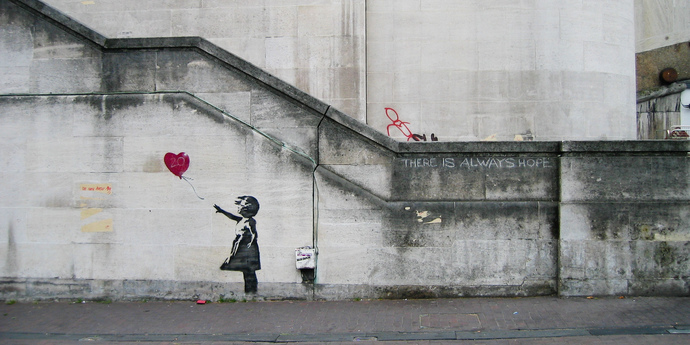
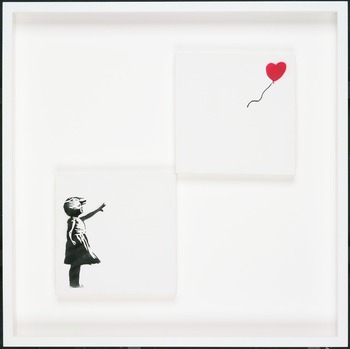
This reminds me of Banksy’s famous balloon girl graffiti: no matter how high marginalized scholars reach for dominant academic standards, the benchmark floats just beyond their grasp. New markers of exclusion emerge, whether it's AI-generated phrasing or subtle stylistic preferences. The epistemic power is essentially, perpetually out of reach.
Power by proximity
What’s more is that the hierarchies are so enthrenced that we even perpetuate them ourselves. Ever notice how the presence of a co-author from overseas university (even one minimally involved) can open doors? Some collaborations resemble power by proximity: local scholars handle the groundwork, while foreign names secure the journal slot. I’ve also seen it time and time again how scholars, especially postgraduate students at local universities, prioritize citations of Western theorists, either because it’s the “norm” or as a strategy for surviving in a system governed by impact factors.
In some cases, being photographed with a visiting scholar carries more value than publishing in a respected local journal. The aim is not just to learn, it’s to signal proximity to power. Want proof? Just look at the promotional posters and documentation of nearly any academic conference; the presence of foreign names and faces is often the main selling point.
But to frame this as a matter of individual choice would be a mistake. These patterns are embedded in the system. Journal accreditation, for example, often has to involve international authors, ideally from the Global North, to achieve higher status or recognition. It's a structural expectation that reinforces the idea that legitimacy must be imported, not locally cultivated.
So what now?
I honestly don’t know. I’m beginning to suspect that my professional choices are political too. I’m drawn to certain ideals, certain methods, certain language not because they’re the ultimate good but because they’re recognized. I edit my tone, soften my arguments, and even sideline my own context to make my work legible to gatekeepers I’ve never met. That’s mainly survival, but it also means I’m complicit in the very system I critique.
Indeed, publishing is not just about writing, but also about how to make one's work seem credible. And right now, legitimacy often hinges on Western norms of language, method, and affiliation. But if we truly believe in the value of diverse knowledge, we need to stop asking scholars to mimic power and start asking what it means to share it. That means rethinking what counts as rigor, what counts as global, and ultimately: what counts at all.
Image credit: 1) By Dominic Robinson from Bristol, UK - Banksy Girl and Heart Balloon, CC BY-SA 2.0, https://commons.wikimedia.org/w/index.php?curid=73570221; 2) By TTTal - Own work, CC BY-SA 4.0, https://commons.wikimedia.org/w/index.php?curid=138716523

