PUBLISHING IN THE AGE OF AI: WHAT YOU NEED TO KNOW
7 October 2024
By Olivia Sandra
For over 350 years, academic publishing has stuck to the same old routine: submit your paper, wait for peer review, make revisions, format, and then wait some more before it finally gets published. Even though technology has advanced, the process can still take months—or even over a year—before a researcher’s hard work sees the light of day. But thanks to artificial intelligence (AI), things are changing, and this could be a game-changer for you as a scholar or academic.
Or so I hope
Why Academic Publishing is Changing
The world of academic publishing is seeing some shifts driven by new policies, tech, and a growing emphasis on being transparent and reproducible. AI plays a big role in speeding things up and making the process smoother. But like any new tech, there are some challenges to keep in mind—mainly making sure AI is used responsibly so it doesn’t jeopardise research integrity.
How Publishers Are Adapting to AI
Publishers are responding in different ways to the rise of AI. Many are allowing researchers to use AI tools like ChatGPT to help write or generate content, as long as they’re upfront about it. You’ll usually see this disclosed in the Acknowledgements or Methods section. However, there’s one big no-no: using AI to generate or process confidential peer review reports. The peer review process is all about trust, and running it through an AI tool could risk that trust.
How AI Can Make Your Life Easier
When used responsibly, AI can actually make your academic life a lot easier. Here’s how:
Save Time and Get Organized: AI can take care of time-sucking tasks like formatting your paper, fixing language issues, and even organizing data. Imagine not having to spend hours reformatting your citations or tweaking the structure of your article!
Help with Translations: If English isn’t your first language, AI-powered tools like Google Translate or ChatGPT can help you translate your research more accurately, making it easier for a global audience to understand your work.
Paper Summaries in Seconds: Need to sum up a paper fast? AI can generate concise summaries, which is a huge time-saver whether you’re writing or reviewing.
Create Visuals Instantly: AI can even help with making graphs, tables, and other visuals for your paper, which saves you from fiddling around with design software.
Level the Playing Field for Non-Native Speakers: AI offers language support that helps non-native speakers express their ideas clearly. This levels the playing field, so no one is unfairly judged by grammar or style issues.
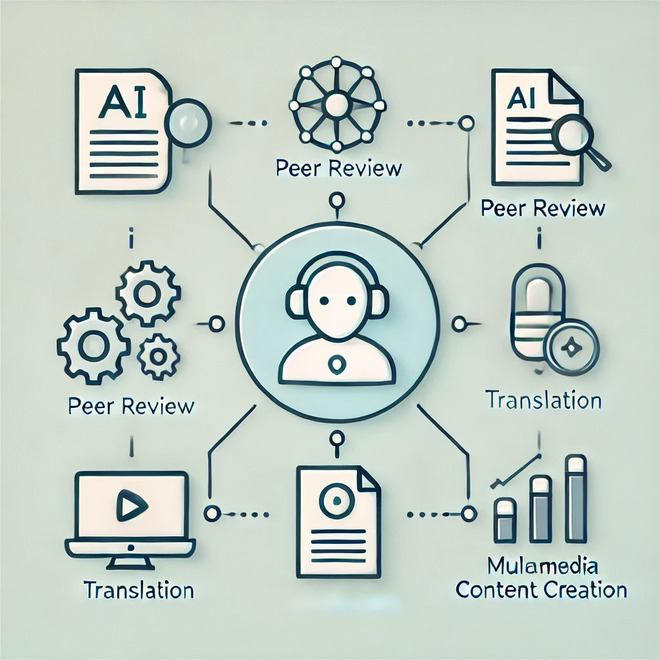
Take Notes for You: If your research involves interviews, AI can transcribe your conversations in real-time, allowing you to focus on listening and asking the right questions.More Ways to Share Your Work: AI can help create multimedia content like videos or audio, making it easier to share your findings with a wider audience. It can even suggest related content to expand your research’s reach.
AI in Peer Review: Helpful but Cautious
AI can quickly detect plagiarism, check formatting, and analyse the text for critical topics. AI can also help editors match your paper with the right reviewers. But let’s be real—AI isn’t perfect, and we still need human judgment to ensure the quality and fairness of the process. While AI can help reduce bias by applying consistent standards, there’s still the risk that it could perpetuate certain biases if not carefully managed.
AI and Journal Operations: A Behind-the-Scenes Boost
From the journal’s perspective, AI is a huge help. It speeds up submission checks, automates routine emails to authors, and even provides strategic insights through bibliometric analysis (basically, fancy data that helps journals see how well their articles are doing). This means editors and reviewers can focus on the content rather than getting bogged down by the admin side of things.
The Flip Side: AI’s Drawbacks
It’s not all sunshine and roses. AI does come with its own set of problems:
Hard to Detect AI-Generated Content: Some AI-generated text looks super convincing, but it might actually contain false information. This makes it tricky for editors to catch, and it puts a lot of responsibility on authors to be honest about their use of AI.
Rise of Paper Mills: Unfortunately, AI is making it easier for paper mills (businesses that sell fake research papers) to produce convincing, fraudulent research. This undermines the integrity of the entire publishing system.
Spread of Misinformation: AI can also unintentionally contribute to the spread of misinformation, especially if it’s used to create research that isn’t rigorously fact-checked. This can be a big problem, as it can blur the lines between legitimate science and disinformation.
What’s Next for AI in Academic Publishing?
The future of AI in academic publishing looks promising, but it’s not without its challenges. AI is likely to become an even bigger part of the process, much like Google or the Internet is today. As AI tools evolve, they’ll continue to help researchers publish faster, with better quality control and accessibility to a global audience.
However, to make this work, we’ll need transparency, fairness, and most importantly, human oversight. AI issue that should assist us, not replace the critical thinking and decision-making that comes with being a researcher, editor, or peer reviewer. If we can get that balance right, AI could completely reshape how academic publishing works, opening up new opportunities for scholars everywhere.
Wrapping Up
AI is already making a big impact on academic publishing and will only become more integrated into the process. Whether it’s helping with tedious formatting, assisting non-native English speakers, or streamlining peer review, AI has the potential to revolutionize the way we share knowledge. But with great power comes great responsibility. As we continue to adopt AI, we must ensure that it’s used transparently and ethically, with a focus on fairness and maintaining the integrity of scientific research.
So, what do you think? Are you ready to embrace AI as a helpful assistant in your publishing journey? I am. I trained the so-called AI to mimic my tone and style in writing this post. And I conjured up those illustrations out of thin air using DALL-E.

